
Donnerstag, 18. Februar 2016

Mittwoch, 3. Februar 2016
Frauenanteil im Unternehmen nimmt in höheren Positionen ab
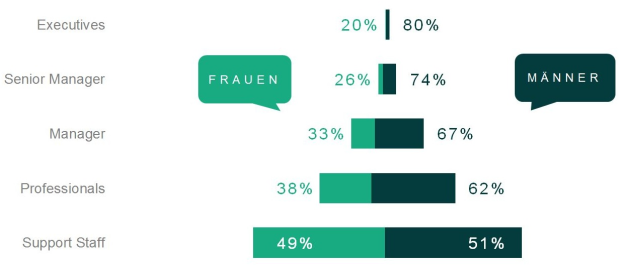
Laut Mercer (Studie, When Women Thrive) sind durchschnittlich 40 Prozent der Gesamtbelegschaft eines Unternehmens weiblich. Der Frauenanteil nehme aber auf dem Weg nach oben mit jeder Stufe ab. Im Management liege er bei 33 Prozent, im Senior Management bei 26 Prozent und auf Ebene der Exekutiven bei 20 Prozent.
Hewlett Packard Becomes German Role Model for Female Executives
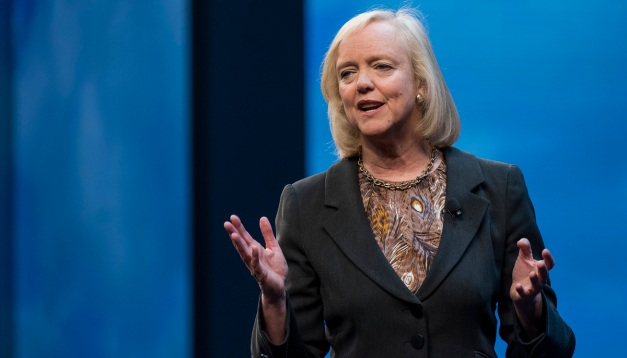
Meg Whitman. Photographer: David Paul Morris/Bloomberg
Hewlett Packard Enterprise Co. is giving German companies a lesson in fostering female talent as firms in Europe’s largest economy remain slow to instill diversity in boardrooms even after government-imposed quotas took effect on Jan. 1.
The Boeblingen, Germany-based subsidiary of HPE, the U.S. technology company led by Meg Whitman, scored highest among 20 companies that participated in the 2015 FKI Women’s Career Index survey. The Kronberg-based research group measured their progress in improving gender balance in the uppermost levels of management of companies based in or operating in Germany. Deutsche Telekom AG took second place with HypoVereinsbank and Intel Corp. also ranking among the top performers.
HPE’s pledge to increase the percentage of women at the highest levels of management to 20 percent by 2020 from 17 percent currently makes it a role model when it comes to implementing legislation that obliges companies to declare targets for executive boards while Chancellor Angela Merkel’s government enforces a 30 percent quota for the supervisory boards that oversee them.
“We can’t rely on quotas for the next 20 years,” said Angelika Gifford, the board member responsible for software at HPE’s German subsidiary. Nor should the purpose of increasing diversity be left to human resource managers, she said. Professional career development “is a task for the management board.”
Set Goals
Deutsche Telekom has aspirations to achieve levels as high as 40 percent at all levels of management, making it a frontrunner on Germany’s DAX Index of 30 biggest companies.
With the appointment of Claudia Nemat to the company’s management board in 2011, Deutsche Telekom was among the first to promote female executives to top management. Since 2014, it has run yearlong programs to train women in the skills required for participation on supervisory boards, placing 8 of those who qualified in the first program on boards at Deutsche Telekom units since completing the course in the summer of 2015.
“It makes sense to set goals and make these transparent,” said Elke Frank, senior vice-president in HR Development at the Bonn-based company. “Diversity is an integral part of business culture in the U.S. We’re only setting out on that path in Germany.”
Jobs Boom
Women are driving a jobs boom in Europe’s largest economy, where unemployment has fallen to a record low. The rapid rise in female participation in the workforce over the past 10 years meant that about 73 percent of women had a job in 2014, up 10 percentage points since 2005, data published by the German Statistics Office showed last month. With 78 percent of people aged between 20 and 64 in employment, Germany is second only to Sweden’s 80 percent in the European Union.
Yet higher participation in the labor market isn’t translating into discernible increases in corporate management. Here, Germany ranks in the middle in Europe, below countries including Norway, France and the U.K., according to a Jan. 13 report by the DIW economic research institute.
Despite the advances spurred by legislation, growth in female representation at German companies is slowing, said DIW. At the end of 2015, the share of women on executive boards of the 200 biggest companies in Germany stood at slightly more than 6 percent, an increase of less than one percentage point on the year.
Black Sheep
While most DAX 30 companies have at least one woman on their supervisory boards, two have no female representation at all: healthcare company Fresenius Medical Care AG and its parent Fresenius SE, based in Bad Homburg.
With 22 percent of the 200 biggest German companies lacking any female supervisory board members or failing to fulfill the quota, “it is highly unlikely that the lion’s share of the remaining companies will follow these trailblazers voluntarily in the near future,” DIW said. “Germany’s companies still have a long and difficult path ahead of them in order to achieve increased representation of women on their corporate boards.”
Leaving it to companies to set their own goals for management boards diminishes the responsibility of corporations in fostering female leadership, said Barbara Lutz, FKI’s founder.
“Even the most engaged companies are only achieving a growth rate of one percent,” she said. “It’s a marathon, not a sprint.”
Freitag, 22. Januar 2016
Donnerstag, 21. Januar 2016
Frauenanteil in Chefpositionen seit zehn Jahren unverändert
 Deutsche Presse-Agentur
 Donnerstag, 21. Januar 2016 15:31 GMT
Nürnberg/Berlin (dpa) – Trotz der Debatte über bessere Aufstiegschancen für Frauen gelingt weiblichen Mitarbeitern der Sprung an die Unternehmensspitze heute so selten wie vor zehn Jahren.
Nach wie vor sei nur jede vierte Chefposition auf der obersten Führungsebene eines Privatunternehmens mit einer Frau besetzt; schon im Jahr 2004 lag der entsprechende Frauenanteil nur bei 24 Prozent, geht aus einer am Donnerstag veröffentlichten Studie des Instituts für Arbeitsmarkt- und Berufsforschung (IAB) hervor. Zwar sei der Anteil im Jahr 2012 vorübergehend auf 26 Prozent gestiegen, im Jahr 2014 aber wieder auf 25 Prozent gesunken.
Verbessert hätten sich dagegen in den vergangenen zehn Jahren die Karrierechancen von Frauen auf der zweiten Führungsebene. Habe der entsprechende Anteil im Jahr 2004 bei 33 Prozent gelegen, seien 2014 bereits 39 Prozent der Stellen im mittleren Management mit einer Frau besetzt gewesen. «Nur auf der zweiten Führungsebene holen Frauen langsam auf», betonen die Autoren der Studie. Dort nähere sich der Chefinnen-Anteil dem Anteil der in Privatunternehmen beschäftigten Frauen (43 Prozent) allmählich an.
Generell hätten Frauen in kleineren Betrieben bessere Aussichten auf die Chefpositionen als in Großbetrieben, im Osten bessere als im Westen Deutschlands, berichten die Nürnberger Arbeitsmarktforscher. Am häufigsten ständen Frauen an der Spitze in Betrieben der Gesundheits- und Erziehungsbranche (43 Prozent), im Einzelhandel (38 Prozent) und im Gastgewerbe (39 Prozent). Am geringsten seien die Aufstiegschancen für Frauen gemessen am Anteil aller weiblichen Mitarbeiter der Branche bei Banken und Versicherungen (12 Prozent).
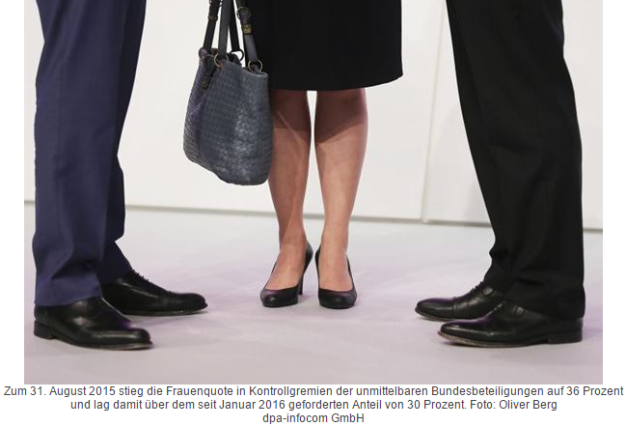
Nach Angaben der Bundesregierung wächst inzwischen auch die Rolle von Frauen in Kontrollgremien von Unternehmen mit Bundesbeteiligung. Zum 31. August 2015 stieg die entsprechende Frauenquote auf 36 Prozent und lag damit über dem seit Januar 2016 geforderten Anteil von 30 Prozent. Der Bund habe damit die Vorgaben zur Besetzung der Aufsichtsgremien mit Frauen in seinen Unternehmen mehr als erfüllt, betonte Finanzstaatssekretär Jens Spahn (CDU). Dagegen waren von den 136 Geschäftsführerpositionen in allen unmittelbaren Bundesbeteiligungen im Jahr 2014 nur 21 mit Frauen besetzt, was einem Anteil von 15,4 Prozent entspricht.
dpa-infocom GmbH
Mittwoch, 20. Januar 2016
Business elite meet to discuss inequality in Davos

Women heavily under represented
The Guardian newspaper published a piece entitled: “Davos: how can an event that’s 82% male solve the digital gender divide?“. Article author Professor Henrietta Moore writes, that in some quarters Davos has become a byword for a champagne-soaked chums club of the global financial elite, personified by the “Davos man”. In 2015 the event listed over four men for every woman. Despite the introduction of a quota of one female speaker for every four men, the female percentage has only grown only 1% this year, from 17% to 18%. Professor Moore writes “we might well ask what a gathering that is so grossly gender-unbalanced is likely to do to close the worrying digital divide between the sexes globally”, one of the topics of discussion at this year’s event.
Donnerstag, 7. Januar 2016
The female quota for leadership positions in Germany is coming
Why we need the female quota
Germany is introducing a female quota of 30% for supervisory boards in market-listed companies from 1 January 2016 on. A decision which is to be greeted from the perspective of gender and diversity! What are the arguments for such a development? An article by Christa Binswanger, Lecturer on Gender and Diversity.
4 January 2016. When I discuss the quota for women in gender and diversity courses with students, the reaction is almost always the same: No way! Supposedly, a person’s performance is not considered under quotas; women are instead given preference due to their gender. And precisely female students do not want this. They want to be taken seriously as professional women.
Why is a quota nonetheless necessary in order to give women the chance to prove themselves as career women? In Germany (as in Switzerland) there has long been a legal right for genders to be treated the same. But the law is not effective when it comes to leadership duties.
Top positions still held by men
In Germany (as is Switzerland), 95% of the top positions in the boards of the largest companies are held by men (94% in Switzerland). This proves the argument constantly promulgated by business representatives that “the market will bring “capable women” to the top all by itself” to be fallacious.
Although German universities have been successfully educating a significant number of well qualified female students in bachelor and master programmes in business studies and economics (as have Swiss ones), their career prospects remain significantly worse than those of their male colleagues. And this irrespective of their performance, but due to their gender alone. Women are promoted less, not only when they become mothers, but also in the first five years after completing university. Around 40% of men move up the career ladder in the first five years after graduating according to a study by the Hochschul-Informations-System (HIS) – for women this figure is just 24%.
That members of the elite prefer to reproduce with each other is not in dispute. Men likewise also prefer to promote men – if they happen to have graduated from the same university then so much the better. What is more disputed is the economic effect this has on a company. Current studies show that mixed leadership teams tend to produce better results than teams comprising similar members – that the “old boy network” practice tends to be detrimental to the company.
However, from the perspective of equal opportunity, the equality argument counts the most. Many women today still do not have equal opportunities on the job market and they are often graded lower than men as it is often assumed that a woman wishes to become a mother at some stage and will then wish to reduce her workload or exit the workforce altogether. For those women who do actually decide to become mothers – the same as for men who wish to become fathers – the compatibility question for work and family will actually be asked later. However, to presume in advance that a woman does not wish to have a career due to potential parenthood at some point in the future is objectionable – regardless of how her familial arrangements might look in the future.
Norway as a role model
As an example, the female quota in Norway has shown itself to be an effective instrument for countering the unequal treatment of the sexes in leadership positions.
A decisive factor for the introduction of the female quota in Germany was Chancellor Merkel softening her position. It is hoped that we will also gain understanding in our country, even if the proportion of women in the federal parliament is currently lower than it has been. It is now customary in Swiss politics to consider party membership and language regions when allocating political functions – a quota rule! However, this appears difficult to implement when it comes to the gender category. The German example may then provide the necessary help in the translation.
Abonnieren
Posts (Atom)