Donnerstag, 21. Januar 2016

Frauenanteil in Chefpositionen seit zehn Jahren unverändert

  Deutsche Presse-Agentur
69Donnerstag, 21. Januar 2016 15:31 GMT
Nürnberg/Berlin (dpa) – Trotz der Debatte über bessere Aufstiegschancen für Frauen gelingt weiblichen Mitarbeitern der Sprung an die Unternehmensspitze heute so selten wie vor zehn Jahren.
Nach wie vor sei nur jede vierte Chefposition auf der obersten Führungsebene eines Privatunternehmens mit einer Frau besetzt; schon im Jahr 2004 lag der entsprechende Frauenanteil nur bei 24 Prozent, geht aus einer am Donnerstag veröffentlichten Studie des Instituts für Arbeitsmarkt- und Berufsforschung (IAB) hervor. Zwar sei der Anteil im Jahr 2012 vorübergehend auf 26 Prozent gestiegen, im Jahr 2014 aber wieder auf 25 Prozent gesunken.
Verbessert hätten sich dagegen in den vergangenen zehn Jahren die Karrierechancen von Frauen auf der zweiten Führungsebene. Habe der entsprechende Anteil im Jahr 2004 bei 33 Prozent gelegen, seien 2014 bereits 39 Prozent der Stellen im mittleren Management mit einer Frau besetzt gewesen. «Nur auf der zweiten Führungsebene holen Frauen langsam auf», betonen die Autoren der Studie. Dort nähere sich der Chefinnen-Anteil dem Anteil der in Privatunternehmen beschäftigten Frauen (43 Prozent) allmählich an.
Generell hätten Frauen in kleineren Betrieben bessere Aussichten auf die Chefpositionen als in Großbetrieben, im Osten bessere als im Westen Deutschlands, berichten die Nürnberger Arbeitsmarktforscher. Am häufigsten ständen Frauen an der Spitze in Betrieben der Gesundheits- und Erziehungsbranche (43 Prozent), im Einzelhandel (38 Prozent) und im Gastgewerbe (39 Prozent). Am geringsten seien die Aufstiegschancen für Frauen gemessen am Anteil aller weiblichen Mitarbeiter der Branche bei Banken und Versicherungen (12 Prozent).
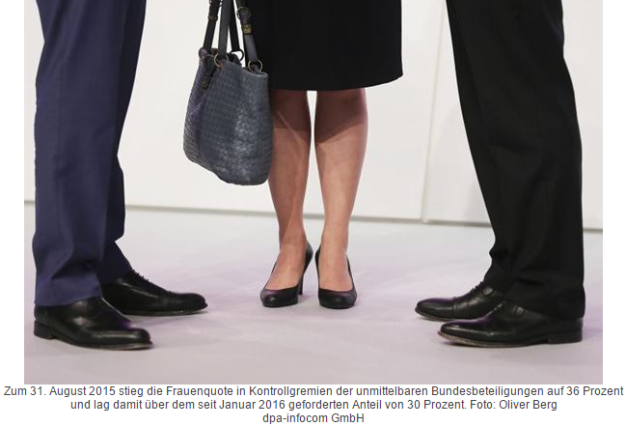
Nach Angaben der Bundesregierung wächst inzwischen auch die Rolle von Frauen in Kontrollgremien von Unternehmen mit Bundesbeteiligung. Zum 31. August 2015 stieg die entsprechende Frauenquote auf 36 Prozent und lag damit über dem seit Januar 2016 geforderten Anteil von 30 Prozent. Der Bund habe damit die Vorgaben zur Besetzung der Aufsichtsgremien mit Frauen in seinen Unternehmen mehr als erfüllt, betonte Finanzstaatssekretär Jens Spahn (CDU). Dagegen waren von den 136 Geschäftsführerpositionen in allen unmittelbaren Bundesbeteiligungen im Jahr 2014 nur 21 mit Frauen besetzt, was einem Anteil von 15,4 Prozent entspricht.
dpa-infocom GmbH

Mittwoch, 20. Januar 2016

Business elite meet to discuss inequality in Davos

wef-logo-653f4063b27b1bd7109b1c678110085f63f6e6d1199566154befc14b51d1de0a

Women heavily under represented
The Guardian newspaper published a piece entitled: “Davos: how can an event that’s 82% male solve the digital gender divide?“. Article author Professor Henrietta Moore writes, that in some quarters Davos has become a byword for a champagne-soaked chums club of the global financial elite, personified by the “Davos man”. In 2015 the event listed over four men for every woman. Despite the introduction of a quota of one female speaker for every four men, the female percentage has only grown only 1% this year, from 17% to 18%. Professor Moore writes “we might well ask what a gathering that is so grossly gender-unbalanced is likely to do to close the worrying digital divide between the sexes globally”, one of the topics of discussion at this year’s event.

Donnerstag, 7. Januar 2016

The female quota for leadership positions in Germany is coming

Why we need the female quota
Germany is introducing a female quota of 30% for supervisory boards in market-listed companies from 1 January 2016 on. A decision which is to be greeted from the perspective of gender and diversity! What are the arguments for such a development? An article by Christa Binswanger, Lecturer on Gender and Diversity.
4 January 2016. When I discuss the quota for women in gender and diversity courses with students, the reaction is almost always the same: No way! Supposedly, a person’s performance is not considered under quotas; women are instead given preference due to their gender. And precisely female students do not want this. They want to be taken seriously as professional women.
Why is a quota nonetheless necessary in order to give women the chance to prove themselves as career women? In Germany (as in Switzerland) there has long been a legal right for genders to be treated the same. But the law is not effective when it comes to leadership duties.
Top positions still held by men
In Germany (as is Switzerland), 95% of the top positions in the boards of the largest companies are held by men (94% in Switzerland). This proves the argument constantly promulgated by business representatives that “the market will bring “capable women” to the top all by itself” to be fallacious.
Although German universities have been successfully educating a significant number of well qualified female students in bachelor and master programmes in business studies and economics (as have Swiss ones), their career prospects remain significantly worse than those of their male colleagues. And this irrespective of their performance, but due to their gender alone. Women are promoted less, not only when they become mothers, but also in the first five years after completing university. Around 40% of men move up the career ladder in the first five years after graduating according to a study by the Hochschul-Informations-System (HIS) – for women this figure is just 24%.
That members of the elite prefer to reproduce with each other is not in dispute. Men likewise also prefer to promote men – if they happen to have graduated from the same university then so much the better. What is more disputed is the economic effect this has on a company. Current studies show that mixed leadership teams tend to produce better results than teams comprising similar members – that the “old boy network” practice tends to be detrimental to the company.
However, from the perspective of equal opportunity, the equality argument counts the most. Many women today still do not have equal opportunities on the job market and they are often graded lower than men as it is often assumed that a woman wishes to become a mother at some stage and will then wish to reduce her workload or exit the workforce altogether. For those women who do actually decide to become mothers – the same as for men who wish to become fathers – the compatibility question for work and family will actually be asked later. However, to presume in advance that a woman does not wish to have a career due to potential parenthood at some point in the future is objectionable – regardless of how her familial arrangements might look in the future.
Norway as a role model
As an example, the female quota in Norway has shown itself to be an effective instrument for countering the unequal treatment of the sexes in leadership positions.
A decisive factor for the introduction of the female quota in Germany was Chancellor Merkel softening her position. It is hoped that we will also gain understanding in our country, even if the proportion of women in the federal parliament is currently lower than it has been. It is now customary in Swiss politics to consider party membership and language regions when allocating political functions – a quota rule! However, this appears difficult to implement when it comes to the gender category. The German example may then provide the necessary help in the translation.

Freitag, 20. November 2015

WEF: Noch mehr als 100 Jahre bis zu echter Gleichstellung

Wie lange müssen Frauen noch warten, bis ihre Gleichberechtigung vollständig durchgesetzt ist? Die Antwort des Weltwirtschaftsforums: Bis zum Jahr 2133 – wenn nicht endlich mehr dafür getan wird.
wef-noch-mehr-als-100-jahre-bis-zu-echter-gleichstellung_pdaarticlewide
Genf. Bis zur vollständigen Gleichstellung von Mann auf Frau in Arbeitswelt, Bildung und Politik kann es nach Ansicht des Weltwirtschaftsforums (WEF) noch mehr als 100 Jahre dauern.
Wenn nicht endlich das Tempo der Angleichung bei Einkommen, Bildung und Aufstiegschancen anzieht, werde dieses Ziel weltweit wohl erst im Jahr 2133 erreicht – also in 118 Jahren. Davor warnt der am Donnerstag vom WEF veröffentlichte “Global Gender Gap Report 2015”.
Rund 250 Millionen Frauen haben der Studie zufolge seit 2006 neu Zugang zu den globalen Arbeitsmärkten erhalten, zugleich halte jedoch die Lohnungleichheit weiter an. “Frauen verdienen heute so viel wie Männer vor einem Jahrzehnt”, heißt es in dem Report zur anhaltenden Ungleichheit zwischen den Geschlechtern auf dem Arbeitsmarkt und in weiteren Bereichen der Gesellschaft.
Insgesamt habe sich die Chancengleichheit in den Bereichen Gesundheit, Bildung, Wirtschaft und Politik in den letzten zehn Jahren zwar leicht verbessert – um vier Prozent nach den zugrunde gelegten WEF-Indikatoren. Jedoch schließe sich die ökonomische Schere zwischen den Geschlechtern immer noch viel zu langsam.
In 22 Prozent von 145 untersuchten Ländern sei die Lohnungleichheit zwischen Frau und Mann seit 2006 sogar größer geworden. Und obwohl in 97 Ländern mehr Frauen als Männer studieren, machen sie in nur 68 Ländern die Mehrheit an Fachkräften aus und in nur vier Ländern haben sie die Mehrheit bei Führungspositionen.
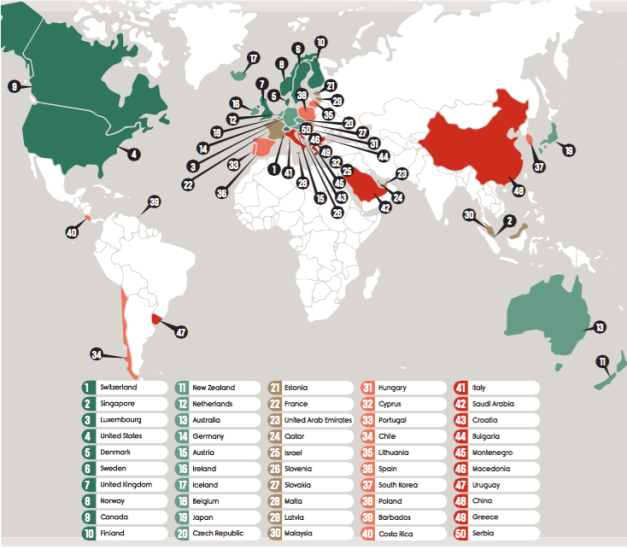
Wie schon in früheren Jahren verzeichnen erneut die nordischen Länder die meisten Fortschritte bei der Gleichstellung der Geschlechter. Auf dem “Global Gender Gap Index” des WEF rangiert Island an erster Stelle, gefolgt von Norwegen, Finnland, Schweden und Irland. Auf dem sechsten Rang steht laut WEF das kleine ostafrikanische Land Ruanda, das seit Jahren beispielhafte Fortschritte in Sachen Geschlechtergerechtigkeit erzielt habe. Auch die Philippinen (Rang sieben) sind demnach in dieser Hinsicht selbst für viele industrialisierte Staaten ein Vorbild. In den “Top Ten” folgen die Schweiz, Slowenien und Neuseeland. Deutschland verbesserte sich im WEF-Gleichstellungsranking gegenüber 2014 um einen Platz auf Rang elf. Die USA fielen um acht Plätze auf Rang 28.
“Die wachsende Automatisierung infolge der vierten industriellen Revolution wird sehr wahrscheinlich nicht nur die Wirtschaft, sondern die gesamte Menschheit verändern”, erklärte Klaus Schwab, der Gründer und Vorstandsvorsitzende des WEF. “Vor diesem Hintergrund müssen wir uns um eine Welt bemühen, in der die Beiträge und Ideale von Frauen eine ebenso hohe Wertschätzung erfahren wie die von Männern.”
Für die WEF-Studie wurden 145 Länder nach einheitlichen Kriterien hinsichtlich der Geschlechterdisparität beurteilt. Untersucht wurden unter anderem Chancengleichheit, Gehälter, Zugang zu Führungspositionen sowie zu höherer Bildung und politischen Entscheidungspositionen ebenso wie geschlechtsspezifische Unterschiede hinsichtlich Gesundheit und Lebenserwartung.
dpa

Freitag, 30. Oktober 2015

Boardroom equality improves but few women occupy key roles

M&S and Kingfisher lead charge for female board representation but executive quotas maybe needed to boost numbers of women in the boardroom
56
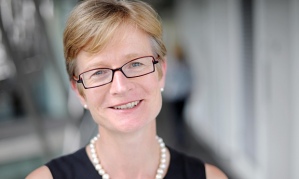
Laura Wade-Gery, an M&S executive director. Photograph: Marks & Spencer/PA
Congratulations to Marks & Spencer and Kingfisher, the owner of B&Q. The two retailers have not enjoyed the easiest time on the high street in the past five years, but they have led the way in the battle to increase female representation on Britain’s boards.
M&S and Kingfisher only rank sixth and third in the FTSE 100 in terms of the proportion of directors who are women, 41.7% and 44.4% respectively. However, they each have two full-time female executive directors which marks them out from their peers. M&S has Helen Weir, the finance director, and Laura Wade-Gery, the executive director for multichannel, while Véronique Laury and Karen Witts run Kingfisher as chief executive and chief financial officer.
For all the progress made by FTSE companies since the launch of the government-backed Davies review in 2010, women remain staggeringly unrepresented in the key decision-making roles at Britain’s top companies.
Lord Mervyn Davies set a target almost five years ago that 25% of FTSE 100 board members should be women, up from 12.5% at the time. That target has been reached – a major achievement – and the UK now ranks sixth in the world in terms of the number of women at the top of its leading companies. However, there is still much more to do.
The target has been reached largely by companies bringing in women to part-time non-executive roles. There are now 143 more female non-executive directors in the FTSE 100 than at the start of 2011.
However, there are just eight more female executive directors, which is unacceptable. This means that women make up just 9.6% of executive roles at FTSE 100 companies.
While the achievements of the Davies review must be applauded, the battle for gender equality within businesses can only really be achieved by an increase in the number of women executives. Hiring a woman who has prospered within another business to be a non-executive director is one thing, but creating a culture whereby women can rise up the ranks within a business to become an executive director is entirely another.

57
A third of boardroom positions should be held by women, UK firms told
It is disappointing, therefore, that the Davies review has not yet set a target for the proportion of FTSE 100 executives who should be women. The CIPD has said this should be set at 20% at least.
To be fair to Davies, who is now stepping aside from his role at the helm of the campaign, he said he would strongly recommend to his successor that executive targets are introduced.
Britain has come along way since Davies started gathering evidence in the autumn of 2010. The approach of setting a voluntary target rather than implementing a legislative quota has made an impact.
But what happens next is vital. Britain’s leading companies must kick on towards a 50-50 representation and increase the number of female executives. If not, then calls for a quota system – used by most of the countries above Britain in the global legal table – will grow louder.
The western economy may be recovering from the financial crisis, but big business is not enjoying the ride.
Many of the world’s leading companies have reported results this week, with shrinking profits, job losses and cuts to capital expenditure a common theme.
On Thursday, Royal Dutch Shell, Barclays, and Deutsche Bank were the latest companies to post mixed results.
Varying reasons lay behind the results, including falling oil prices, regulatory issues and a slowdown in China, although some big businesses are still performing well, notably Apple, the biggest of them all.
It is a notable reversal of fortunes from a few years ago, when the US and European economies were struggling to bounce back from recession while big business were sitting on record cash piles.
Could we now be seeing the fruits of companies choosing to use that cash to keep their investors happy with dividends and share buybacks rather than investing it in their operations?
 Bold BT, ahead of the curve?
One company that has invested heavily and is enjoyingthe rewards is BT. The company shocked analysts in 2012 when it first bought rights to buy Premier League football matches.
Since it moved into sports broadcasting, shares in BT have more than doubled. The company’s latest results show that an extra 106,000 customers signed up to its television service in the last three months, a record performance.
Gavin Patterson, BT’s chief executive, aided by his predecessor Lord Ian Livingston, is reaping the benefit of a bold move ahead of the curve. Patterson is now trying to do the same again, at an even greater cost, by buying mobile operator EE for £12.5bn.
by: http://www.theguardian.com/business/2015/oct/29/boardroom-equality-improves-few-women-occupy-key-roles